_edited.png)
Triathlon Review: 70.3 Shanghai-Chongming
Updated: Jun 4
A Comprehensive Guide To Racing Ironman 70.3 Shanghai-Chongming
*This is a review based on experiences at the 2026 race.

Photo by Paul Higgins
Chinese Triathlon Community
So much of the content at Travelled Triathlete is through the lens of my experiences (Rachel, the writer). While this perspective informs us of what it is like to be a guest, solo traveller or interracial heterosexual couple from the west- it misses the perspective of those who are the most important. The people who welcome us to their community and share the experience with us. We were able to talk to a few experts within the Chinese Triathlon Community and asked them to share one or more of the following things:
What is the best part about the triathlon experience in China?
If someone was travelling to China for the first time to do a triathlon, what would you like them to know?
Optional: Is there anything tourists do that you find a little funny.
First up, Emma.
Emma Cai is a Chinese age group triathlete AND race commentator. She's done some of triathlons most iconic races, including Challenge Roth! She brought the energy on race day and was one of the race commentators for Ironman 70.3 Shanghai- Chongming. We had the privilege of getting to know Emma during race week and asked her what she would want to tell people who may have never been to China for a triathlon.
"1. Don't be afraid, China is really safe. 2. Download the VPN before you arrive in China. 3. If you need any help from the race organizers, just email them before you arrive. "
Emma also let us know that "Triathlon is still a pretty new thing in China, the rules or the referees things are very different with in Europe or North America." This may require international athletes to put more emphasis on reading the athlete guide. She recommends athletes " Collect the information and questions earlier, and ask them at the briefing". She also recommends that athletes book the official race hotel for convenience and access to shuttle to the Ironman village/hotel/airport to avoid any confusion surrounding traffic guidelines.
The next perspective we have is from Zhang Biyun. We met her at a meal during race week and ended up getting to cross paths a few times. When I asked her if she would like to share her thoughts on this race review she provided such excellent feedback. Before we get into her feedback, get to know her in her own words.

Photo provided by Zhang Biyun
"My full Chinese name is Zhang Biyun. I go by “Sister Biyun” online and my English name is Thalia. Strava:Thalia Zhang I am a content creator focusing on active lifestyle with nearly 700,000 followers across Chinese social media platforms. Most of my content covers triathlon, cycling, travelling and gourmet food, which are also my personal hobbies and shape my perspectives in our discussion. I started systematic triathlon training in September 2024. Since then, I have finished the full-distance Ironman in Hamburg, Germany, multiple Ironman 70.3 races as well as the 70.3 World Championship held in Marbella, Spain last year. Triathlon, cycling and running have become indispensable parts of my daily life. I earned my master’s degree in Media and Public Relations at the University of Leicester in the UK years ago. My overseas study and living experience enables me to understand cultural differences between China and Western countries from both sides’ viewpoints.
Photos provided by Zhang Biyun As triathlon is still a niche but fast-growing sport in China, I hope to act as a communication bridge between Chinese and international triathlon communities via my content, sharing racing experience, sports culture and insights from both regions."
She provided us with such thoughtful answers to the questions we posed that I've quite literally copied everything in her own words below. If there is one thing that you take from this entire race review, it's this.
Question 1: What is the best part about the triathlon experience in China?
"Regarding your first question about the best experience of competing in triathlons in China, I’d like to share my insights based on my competition experience both home and abroad. I take part in 2 to 3 Ironman races overseas and another 2 to 3 domestic triathlons every year, which lets me notice obvious gaps between events at home and abroad. First, overseas Ironman races feature higher overall professionalism and stronger athlete competitiveness. I struggle to achieve high rankings especially in European competitions, yet I can often claim the top spot in my age group at domestic standard-distance triathlons. Second, most domestic triathlon events follow the Olympic standard distance. Full-distance Ironman and 70.3 races are quite scarce in China, so foreign athletes will have limited options if they plan to look for races of these distances. Still, competing in China brings distinctive highlights: 1. Most domestic triathlon organizers cooperate closely with local governments, as events serve to boost local tourism and culture. Therefore races are always hosted at scenic spots with stunning natural views. 2. Benefiting from China’s advanced infrastructure, events offer premium hardware support. Roads for cycling segments are normally fully closed to regular traffic with wide and smooth pavement, greatly securing competitors’ safety, plus comprehensive on-site race support services. 3. Supported by local authorities and organizers, plenty of brands sponsor domestic races. Take the Chongming triathlon in Shanghai as an example: athletes receive elaborate goodie bags stuffed with various trial products. By contrast, non-Ironman races overseas usually only provide a simple drawstring bag. The biggest perk of racing in China is the perfect combination of competition and travelling.
Competitors can visit remote, scenic destinations they would hardly reach otherwise, exploring local history, culture, landscapes and unique cuisines alongside their races. China boasts vast territory and diversified local customs, so every race in a new city delivers a brand-new cultural experience. This charm attracts international triathletes and motivates domestic triathlon enthusiasts to travel around for races.

Photo by Nabeel Chirathodi For Question 2: If someone was travelling to China for the first time to do a triathlon, what would you like them to know? Based on my previous communications with professional cyclists who’ve raced in China, my top tip is to set aside ample spare time for your trip. As I mentioned in my answer to the first question, competing in China perfectly combines race experience with sightseeing. Therefore, I don’t recommend planning your trip solely around the triathlon. Instead, arrange a full itinerary covering both the competition and local travel, and make travel plans in advance.
China has relaxed its visa policies over the past year, bringing a growing number of foreign visitors. Detailed China travel guides are widely available on YouTube and other overseas social media platforms.
After the race, athletes can extend their stay to explore nearby cities and get an in-depth taste of China.
Another essential preparation is to set up mobile payment services like Alipay and WeChat Pay before arrival. Cash is rarely used in daily life across China nowadays. With a smartphone and payment QR codes, you can take subways, buses and high-speed trains, book flights, as well as pay for groceries and dining anywhere. Life in Chinese cities heavily relies on mobile payment, and lacking access to these services will cause huge inconvenience during your stay. Lots of tutorials on setting up these payment apps for overseas users can be found on TikTok and YouTube. You just need to link your foreign bank cards to Alipay or WeChat Pay, so there is no need to bring large amounts of cash. This is the most important preparation ahead of your China trip.

Photo by Nabeel Chirathodi
Question 3: Is there anything tourists do that you find a little funny? The third question is really interesting, as it largely stems from cultural differences between China and Western countries. I’ll illustrate it with real experiences I had chatting with pro cyclists who came to China for professional road grand tours.
Many local Chinese delicacies consist of animal offal, animal heads and feet, such as chicken feet, duck feet, rabbit heads, pork brains and pork intestines, which are hugely popular among Chinese people. However, most Western athletes would refuse to try these dishes on their first visit to China. That said, some foreigners who have lived in China for years grow fond of such food. A handful of long-term expats who know Chinese culture extremely well even open their own hot pot restaurants serving these specialty ingredients. Since food is an indispensable part of daily life, it’s better for incoming triathletes to learn about these culinary differences in advance and get mentally prepared.
I can assure them all these foods are safe, tasty and not gross at all. If they cannot bring themselves to have a bite, it’s fine too — at least they will know such local food exists. I’ll focus only on this food-related cultural difference for this part.
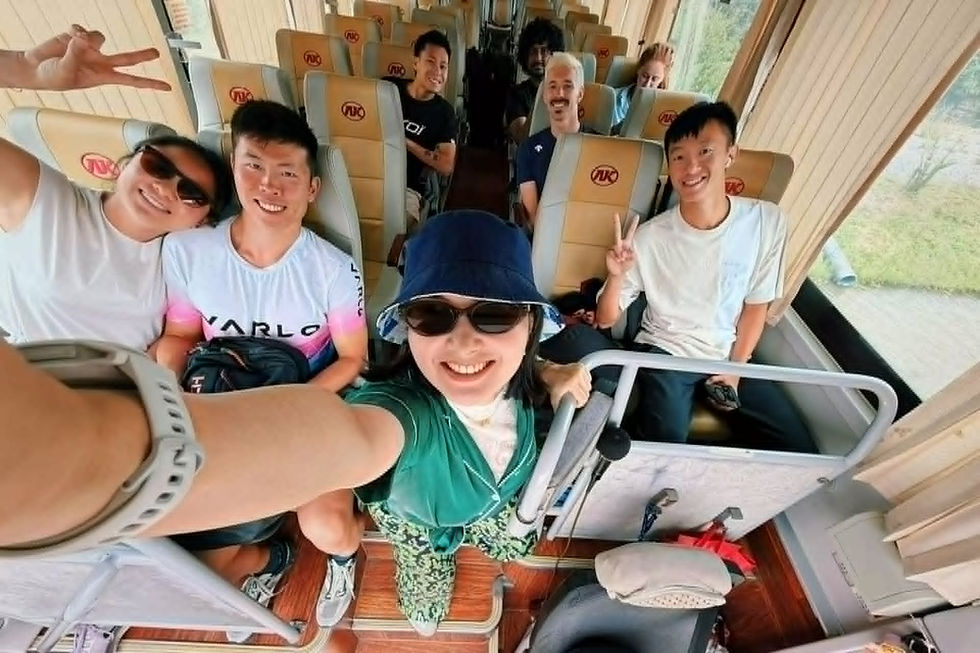
Photo provided by Zhang Biyun
A huge thank you to both Thalia and Emma for their feedback. This race review holds particular value to me which is wholly attributed to it being a collaboration between new friends.
Pre Travel:

At the time of our trip, Canadian passport holders DO NOT require a visa to enter China. However, visa policies can change, so we highly recommend checking with your country’s official travel advisory or consular services for the most current information before departure.
Our co-writers hold American Passports and DO require a visa to enter China.
To help us prepare, we found the following apps and tools especially useful:
Translation App – We downloaded both English and Chinese for offline use, which made navigating signs and conversations much easier.
Amap– For accuracy, use Amap rather than other map or GPS software
Klook – Great for booking transit, attractions, and local experiences in advance.
Alipay –Alipay is used for a lot of different things, from paying to an in-app Didi.
Didi– This is a transit app. It offers a mix of vehicles similar to Uber as well as Taxis.
WeChat: This can be used for payment, messaging, food delivery etc.
Photo provided by Ironman 70.3 Shanghai Chongming
Personal Note:
I was unable to complete this race due to a muscular injury on the bike. To get an accurate picture for this race review a couple of my friends who did complete this race helped me co-write. A huge thank you to Olivia Dietzel and Nicole Valentine. This race was my first time getting to meet both Olivia and Nicole.
Olivia came into this race one week after an Extreme triathlon in Nepal where she sustained some unique injuries. If you don’t know Olivia, scroll to the bottom of this review for a bit about her. Naturally a small bio doesn’t tell the whole picture, so you can follow along with her progress here.
Nicole came into this race after a bit of a triathlon hiatus to pursue ultra running and finished strong as 4th FPro! If you don't know Nicole, scroll to the bottom of this review for a bit about her. Just like Olivia, this small bio doesn't capture the whole picture, so you can follow along with her progress here.

Photo of Nicole (left) and Olivia (right) by Nabeel Chirathodi
The Race:
Venue: Chongming Island, Shanghai, China

Registration & Expo:
Registration must be done prior to race day and it opens two days before the race. Everything was clearly marked and well organized with limited lines/wait times. There were many vendors for swim, bike, run and accessories. A big thing to note was that CO2 was limited. When I went to purchase it from the expo the day before the race they said they had previously sold out. Should inventory remain limited in future years, I recommend CO2 acquisition being the first thing you do at the expo.

Photos provided by Ironman 70.3 Shanghai-Chongming
The race packet was one of the better ones that I’ve received. In addition to all of the race day requirements (timing chip, numbers, cap etc.) it even included a race belt! As well as samples from their sponsors. One thing that I really liked was the sample size bottle of sunscreen.
Reminder: Alipay is widely accepted and at the time of writing this it is heavily recommended that all visitors to China download this app and familiarize yourself with it prior to travel.
Note: There was an Ironkids race the day before the 70.3. I had the privilege of handing out the medals during this event and it looked incredibly fun for young athletes and their families.

Photo provided by Ironman 70.3 Shanghai-Chongming
Swim:
The swim started from a dock and required athletes to jump or dive in from the dock of Bright Tian Yuan. It was incredibly choppy for a freshwater swim. It was very well marked with a buoy every hundred meters that were all numbered. Sighting buoys and turn buoys were clearly marked with different colours. Despite it being choppy, sighting was manageable due to the frequency and size of the buoys.

Photo provided by Ironman 70.3 Shanghai-Chongming
Water Temperature: Usually warm. The final decision for wetsuits are made by the Race Director on race morning. For the professional race it was not wetsuit legal and for the age group race it was wetsuit legal. The water temperature for the 2025 race was 22.3 degree celcius race morning.
The swim start is about a 10 minute walk from transition with a different start and finish location. Give yourself extra time race morning to get to the swim start.
Unique feature: Many athletes I spoke with commented on this swim being hard. Some athletes mentioned higher heart rates than normal. Definitely bring your swim fitness for this race.
The swim exit was also at a dock. The exit dock had a ladder and volunteers to help lift athletes out of the water. Athletes were then required to run up some stairs towards transition.
There were a lot of safety personnel on the swim course.
Photo provided by Ironman 70.3 Shanghai-Chongming
Transition 1:
Transition(s) were fairly straightforward. Athletes racked their bike at the designated area and could leave shoes on their bike (but nothing else). All other equipment was stored in the designated gear bags. Blue for swim to bike and red for bike to run.
Features: change tents separated based on gender, bathrooms, sunscreen stations, medics in transition.
Photo provided by Ironman 70.3 Shanghai-Chongming
Athletes ran up out of the water and grabbed their blue gear bag. Athletes then had the option to bring your gear into a designated change tent or run and drop it off with a volunteer. Volunteers put the gear bags back so athletes didn’t have to hang out in the congested area near the bags. If you are aiming for a fast transition this means you can dispose of your swim equipment into the bag while running/moving towards your bike. If transition time is not a concern for you, this process meant that the racks wouldn’t get as congested with everyone hanging around them. The transition was all grass and there were no notable issues with footing.
Transition exit and mount line were clearly marked.
Bike:
The bike course was two loops, flat and windy. It was well marked with distance markers and cones preventing athletes from taking the wrong turn or going off course. The roads were closed to traffic and event vehicles felt like they were handled safely and at an appropriate distance.
Photo provided by Ironman 70.3 Shanghai-Chongming. First photo on the left is of our Co-Writer Olivia.
This course had a total of three aid stations. Equipped with both water and electrolyte drink. The course guide says that there was also food (bananas and gels), however I had my own gels and did not notice this/wasn’t paying attention to this. Every aid station had bathrooms, sunscreen, a medical tent, and a bike mechanic tent. Bike mechanics also were driving around the course for extra assistance. I did grab one bottle of electrolyte drink and noticed that it wasn’t filled to capacity.

Photo provided by Ironman 70.3 Shanghai-Chongming.
I always suggest being as self sufficient as possible on the race course and would recommend using the aid stations to top up/replace or make up for dropped nutrition rather than relying on them.
Overall the bike course felt extremely safe, with exceptional road quality and appropriate medical staff.
Transition 2:
T2 is quite literally the inverse of T1. Athletes rack their bikes before heading over to the red bag to acquire their run gear and drop off their helmet. Athletes still have access to the change tent, sunscreen, medical and toilets. Volunteers sort the bags to avoid congestion near the rack.

Photo provided by Ironman 70.3 Shanghai-Chongming
Note: Remember athletes must rack their bike before taking off their helmet. This is a universal triathlon rule. Any time an athlete is holding their bike in any capacity, a helmet must be securely fastened.
Run:
Overall the run course is very smooth, flat, with newly paved pavement for the entire run course. The whole course is on paved trails in the park. You go over several bridges but all with good pavement and no hazards.
The run course was very well marked with course marshals wearing high visibility vests at every intersection. Every kilometre was marked and they also had signs about 100 meters before each aid station noting “aid station ahead” in both Chinese and English.

Aerial shot of the start of the run course. Photo provided by Ironman 70.3 Shanghai-Chongming
All roads that motor vehicles could drive on were closed. The majority of the run was on paths in the park though, so no vehicle traffic anyway. Olivia stated that she had “Absolutely no concerns with vehicles getting close to athletes. Extremely controlled and safe environment”.
Medical support was great with several medical stations on course (separate from the aid stations) with full medical staff and supplies. Luckily neither Olivia nor Nicole require medical assistance to confirm which supplies were on course but confirmed that the tents were bright red (so you couldn’t miss it).
Olivia noted that “the run course is completely exposed to the sun with zero shade. With the heat and humidity and black pavement, it gets very hot running. The path is lined with short trees on both sides and the trees aren’t tall enough to provide any shade in the midday sun, but they block a lot of the wind, so you don’t get to take advantage of the strong breeze for cooling." Nicole shared this experience, noting that "The run course featured bridges, flowers, and vegetation, and was unique in that it was through a scenic natural area. Unfortunately the trees and vegetation were low lying, so about 95% of the run course was in full sun. It was humid and quite warm in Chongming with the high temperature being nearly 80 degrees F/ 27 C."
Photos provided by Ironman 70.3 Shanghai-Chongming
In terms of race strategy, Nicole notes that "The course consisted of a large loop, with the out and back separated, so there are few points where you have an opportunity to see your competitors, or other runners besides those right behind and just ahead of you. The exceptions were at the turnaround for the first lap to head out for the second (near the finish line), and the turnaround half way through the second loop to go back to the finish."
On this course there were 10 aid stations, located approximate 1.2-2km apart. Olivia didn’t think that was enough. She noted that In the pre race briefing, they said there would be ice. There was no ice. The aid station volunteers were saying “ice” holding up wet sponges. The sponges were cold but most of the other drinks at the aid station were room temp or air temperature.
Nicole carried a hand held run water bottle and (she) highly recommends it for others that drink a lot of fluids or are concerned about running in the heat. The run aid stations were really well stocked - far better than some (she's) experienced at other Ironman or Challenge races. Every aid station had water, electrolyte drink, cola, gels, and cold sponges.
Tip: In hindsight, Nicole carrying a hand held water bottle was a really smart strategy. It was not part of my pre-race plan (the run nutrition I packed was exclusively gels with the intention of relying on aid stations). Many people stated how hot this run course is.
Both Olivia and Nicole noted that the run course because of the design of the run course, it was not spectator friendly, and spectators should just plan on staying around the turn around to start lap 2 and then head to the finish.
The course is long. It’s 0.1 miles longer than 13.1 (and (her) watch usually reads short).
Photos provided by Ironman 70.3 Shanghai-Chongming
Additional Notes: Olivia noted that the post race food wasn’t great. If athletes wanted a meal they would be required to buy it from the expo.
Port O Potties race morning might not have any toilet paper. If you are travelling from the west this may be a different experience so make sure you pack some toilet paper in your race bag.
The venue is fairly spread out. From the expo/finish/ shuttle drop off to transition is a little over 1.5 km (close to a mile) and transition to swim start is another 10-15 minute walk.
Give yourself lots of time on race morning because there’s a lot of walking from place to place.

Photo provided by Ironman 70.3 Shanghai-Chongming
A really nice feature of this race was the event and course photographers. All photos were available shortly after the race on their website free of charge. This is in direct contrast to many other race experiences where photos are available for purchase only.
Scoring Note: Based on the scoring guide criteria, Ironman 70.3 Shanghai received a perfect score. However, it's important to note the caveat:
There is nothing in the scoring guide about how well stocked aid stations are. At this point this is intentional because I am racing in the WPro category. In the pro category some brands of races have different policies surrounding aid station support (for example, at the time of writing this both Challenge Roth and Challenge Salou allow support persons to give athletes bottles etc on the course) and/or I can not speak to how well the aid stations are stocked for all athletes (meaning if aid stations run out of products near the end of the race). For these reasons, to maintain a similar scoring guide across all races this is not included in the scoring. The frequency of aid stations on the run and lack of full bottles on the bike are the only subjective critiques of this race, and it is important to note that it is not reflected in the score.
Curious about how we score races? Take a look at our Scoring Guide here.
Pre Race Training And Accommodation:
A unique feature to this race was that athletes were emailed a travel guide for international athletes. This included things like preparing Alipay etc.
We stayed at an official race hotel, Flower Expo State Guest Hotel (花博迎宾馆) This meant that a shuttle came right to our hotel surrounding the race events (expo, race morning, awards etc). This shuttle can get busy and is on a specific schedule.
For training before the race there is a public swimming pool. Athletes require Wechat to sign waivers and the hours were around 11:30-8pm). The address is: No. 7398, Tuancheng Road, Chongming District.
Note: No swimming is allowed in the lake outside of the practice swim the day before the race.
It is really easy to bike around Chongming. The road quality is excellent with large bike lanes.
Note: There are a lot of slow moving scooters in the bike lanes and they might cross lanes or turn unexpectedly so just be vigilant when riding.
Just like cycling, it was incredibly easy to find safe locations to run in Chongming. Though no accommodations are near the race venue, Chongming does have an appropriate quantity of accommodations. It was easy for athletes to find hotels of various price points along the provided shuttle routes and I did not notice any price markups.
Chongming had sufficient medical and recovery facilities for athletes' needs prior to the race as well as bike shops. I required a new bolt for my BTA water bottle cage and was able to easily access this at GIANT Bicycle on Yulinqiao road.
Additional Notes:
Food: The writers of this post had a few different dietary requirements. I (Rachel) ate vegetarian and Olivia sought non spicy foods. When coming to this race don’t expect to find foods from western regions in the grocery store. Be ready to be flexible and fluid. There is a large grocery store at the base of Wanda Plaza as well as some restaurants. I did find some with vegetarian options but it does require a bit of a search.
Chinese Number Limitations: Some things are limited without a Chinese number. Including many food delivery apps, getting wifi in public places (includes hotels). So it is recommended people use an international sim or phone plan.
Visas: At the time of writing this Canadians did not need a Visa to enter China. This is new to this year and is a policy that is fluid. It is recommended that everyone check out their Visa requirements before travel. Our American co-writer noted that for Americans the visa application is extensive and takes weeks to months to get. Olivia used the pass through visa option where if the last destination before china and first destination after china are not the same country you can visit China for up to 10 days without a visa. Layovers count.
Post Race Sightseeing:
Chongming Island is a relatively rural island. It is still considered part of Shanghai but is separated from the city (quite literally by water).
A lot of the sightseeing in Chongming is ecological gardens and parks. Before the race we visited: Shanghai Gaojiazhuang Ecological Garden. This garden consisted of a lot of mini gardens (bamboo forest, walking and exercise paths, wishing well etc. Most of the in-park facilities were closed (restaurant etc) at the time that we visited.
Shou'an Temple is the oldest temple complex on Chongming Island. It's origins date back to the Song Dynasty (960-1279). The temple was founded by monks from Sichuan province and first called Fu'an Temple (conveying hope for prosperity and well being for locals). During the Yuan Dynasty (1271-1368) it was renamed "Yongfu Shou'an Temple", which means "temple of eternal blessings and long-lasting peace". This temple has free admission.
Location: No 1188 Taosheng Road, Chengqiao town, Chongming district.
Photos by of Shou'an Temple by Paul Higgins Dongping National Park: This park has things like zip lines, camping, wildlife and hiking. It is located at: No 2188 Beiyan Highway, Chongming district, Shanghai Fun fact: The Dongping National Park hosts a Sleep In Forest competition on World Sleep Day. Metrics like sleep latency, total sleep duration, deep sleep percentage and sleep continuity are measured and there IS prize money up for grabs. Fun Fact: Chongming is host to The Tour of Chongming Island is an annual elite international women's cycling race consisting of a one-day race and a stage race. The hotel we stayed in has a display set up to honour this event.

Photo by Rachel Faulds
After the race we went into the heart of Shanghai and stayed near Nanjing Road (Chinese: 南京路). In order to appropriately access the transit system (and not be weighed down by our large luggage) we used the luggage storage option at Pudong Airport (Notes on this).
Pudong Airport Luggage Storage: We stored a large bike box and two large suitcases from Monday at 12:30-Wednesday at 12:30 for a cost of approximately $72 CAD. At the time of writing this, luggage storage is available at both terminals at Pudong Airport. We used Terminal 2 and the luggage storage was opposite Gate 1/ Area A on the arrivals floor. Hours are 07:00-23:00.
This was extremely convenient for us. For the ‘sight seeing’ part of our trip we were able to travel with two backpacks which allowed us to comfortably use public transit and move around the city. I definitely recommend this service.
The main focus of our time was using the transit system (we were excited about the Maglev), eating some good food, heading to some parks, and visiting a couple of specific stores: Culture Matters (specifically for Feiyue by Dafu Rubber Co. Ltd - a shoe company founded in Shanghai), stationary stores, and Anta.
Along the way we discovered a few extra cool places, but for the sake of brevity on this race review - head to our Shanghai Destination Deep Dive to get the full picture.
Words to Know:
English is not widely spoken, especially in smaller shops or by volunteers, so knowing a few words can go a long way:
Ni Hao (你好) – Hello
Xie Xie (謝謝) – Thank you
Shui (水) – Water
Jia You! (加油!) – A cheer meaning "Go!" or "Keep it up!" You'll hear this a LOT on race day.
Triathlons in China
Closest Airport: Xiamen Gaoqi International Airport (XMN)
Closest Airport: Shanghai Pudong International Airport (PVG)
Closest Airport: Dali Fengyi Airport(DLU)
Where to Stay:
We stayed at one of the official race hotels. This allowed access to the shuttle on race weekend. However, athletes are not required to stay at a race hotel to access the shuttle. If you would like to stay elsewhere or the race hotel is sold out, I recommend staying near Wanda Plaza. This location is proximal to a public swimming pool, many food locations and the race organization includes a shuttle drop off point at Wanda Plaza.
Tips and Tricks:
Plan your nutrition in advance, including whether you’ll rely on the on-course aid stations. If you’re using the course nutrition, make sure to practice bottle grabs during training and check what products will be provided ahead of time.
Pack a flat repair kit, including spare tubes or CO₂ if you’re racing tubeless. The road quality on Chongming Island was incredible and there was a lot of mechanical support. However, it’s always important to plan on being self-sufficient as possible.
Bring your own pump for race morning if possible. There are some available in transition, but lines can get long and pressure gauges may vary.
Arrive early on race morning to allow time to check your bike and wait in the toilet lines—which can be quite long, especially just before transition closes.
Tip: Although your bike will already be racked in transition, you'll still need to pump your tires on race morning. While you're there, double-check that your bike is in the gear you want to start in, load your race-day nutrition, and take time for a short warm-up to get your body moving.

Race-Specific Notes:
Familiarize yourself with the local transit system. It is not possible to stay within walking distance of the venue. On the days surrounding the race Didi can be hard to access (due to long wait times). The organization provides shuttles, so familiarize yourself with the schedule.
Bring Toilet Paper in Your Race Bag: Port O Potties race morning might not have any toilet paper. If you are travelling from the west this may be a different experience so make sure you pack some toilet paper in your race bag.
Ensure you have appropriate apps: China is really tech heavy, using apps for most payments (Alipay) and transit (Didi).
Spread Out Venue: Give yourself lots of time on race morning because there’s a lot of walking from place to place.
Photographers on Site: Ironman 70.3 Shanghai- Chongming provided event and course photographers. All photos were available shortly after the race on their website free of charge. This is in direct contrast to many other race experiences where photos are available for purchase only.
Rural Location: The race location is in a rural location. For support crew, plan on being on site the whole day (aka not heading back to the hotel to rest). Additionally, it is not the most spectator friendly with visibility spots being surrounding transition and the finish. For entertainment they do have a great live stream/video playing but you may not be able to see your loved one. Using the appropriate Ironman Tracker is recommended.
Cost:
The local currency is the Chinese Yuan. At the time of writing, approximately 5 Chinese Yuan equals $1 CAD.
Credit & Cash
Credit cards are partially accepted, especially in hotels. However, Alipay is more widely accepted.
Tipping Culture
Tipping is not expected in China and is not a common practice.
Accommodations
There is a wide range of accommodation options in and around Chongming. On average you can expect to pay $80–$150 CAD per night.
Food Costs
Food in China can vary in price.
Meals at small restaurants: $8–$10 CAD per person
Mid-range restaurants: $10–$20 CAD per person
Buffets, Western-style or tourist-oriented restaurants may cost more: $30-50 CAD per person
Transportation
Taxis and Didi within Chongming typically cost $4–$20 CAD per ride (depending on distance). There are no Uber or Lyft services in the area.
Train: Within the main part of Shanghai trains and subways are easily accessible.
Race Entry Fee
At the time of writing this, the cost of an entry fee for a 70.3 in China is CN¥3,091.67. This works out to approximately $627 CAD.
Expo & Merchandise
There is no fee to enter the race expo, but as with most large races, vendors will charge for a wide assortment of products.
A huge thank you to Olivia Dietzel and Nicole Valentine for helping me with this race review. Olivia Dietzel: Olivia (Liv) was born and raised in Dickeyville, Wisconsin. She discovered her love for endurance sports when her high school gym teacher convinced her to give running a try. Deemed “not worth investing in” by her track coach, she didn’t pursue running at the collegiate level. After college, she took up cycling as a father-daughter bonding opportunity. Liv signed up for her first Ironman in 2019 as a fundraiser for brain cancer research in honour of her father, who was battling glioblastoma (GBM). After finishing that “one-and-done” Ironman she was hooked. Losing her father in 2020, Liv now had a powerful “why” for racing . No matter where her triathlon career takes her, she will never forget her “why” and will always race in honour of her father, her biggest fan.
Follow Olivia on Instagram at: @olivia.dietzel

Olivia Dietzel: Photo By Ironman 70.3 Shanghai Chongming
Nicole Valentine is a professional triathlete, performance coach, and founder of Nicole Valentine Coaching. She helps high-achieving women in their 40s and beyond harness endurance training principles to achieve bold goals in business, health, and life. A top-5 finisher at the Kona Ironman World Championships and 4th-place pro at Leadville 100 MTB, Nicole brings elite-level grit and strategy to her coaching. After leaving a successful corporate career to go pro at 33, she built a global coaching business, moved to Spain, and opened a retreat center to empower women to redefine their limits. Drawing from mentorships with legends like Siri Lindley and Dave Scott, Nicole blends mindset, discipline, and goal-setting to spark transformation. She’s been featured on the Feisty Tri and Ironwoman Podcasts and speaks regularly on high performance and reinvention. Her mission: help women live boldly, lead with purpose, and go after what truly matters.
Follow Nicole on Instagram at: @nicolevalentinecoaching
Website: https://nicolevalentineracing.com/

Nicole Valentine: Photo By Ironman 70.3 Shanghai Chongming
Please note that this post was written from my perspective and experiences. Your experiences may vary. Please read the Canadian travel advisory (or your own countries travel advisory) prior to travel.


