_edited.png)
Triathlon Review: Challenge Gunsan-Saemangeum
A Comprehensive Guide To Racing Challenge Gunsan-Saemangeum
*This is a triathlon review based on experiences at the 2026 race.

The LOC
Triathlon Definition:LOC: Local Organizing Committee
When scoring races I use a guide/rubric. The intent here is for continuity between race reviews and to provide a quantifiable review and feedback on the race infrastructure. One of the biggest things that stood out to me for Challenge Gunsan-Saemangeum was outside of any metric I’ve ever scored for a race, it is entirely subjective and hard to quantify.
This event has all of the infrastructure of large triathlon competitions. Streamlined registration process, expo with required last minute gear and appropriate vendors, an entirely carpeted 700m run up to transition etc (we’ll go into more detail on the actual race review) but the feel of a local race.
What I mean here is that feeling that made a lot of athletes fall in love with the sporting community in the first place. The feeling of driving up to your local race that you’ve done annually, efficient and direct communication with the race director, and most notably- immediate response to athlete feedback. It’s hard to quantify the feeling that I’m talking about, but when I spoke to athletes with varying decades of experience from different corners of the world - we agreed that this race was special. It felt big and local at the same time. I credit this entirely to the continuous effort of all members of the LOC, particularly both James and Kevin.
Pre Travel:
At the time of our trip, Canadian passport holders DO NOT require a visa to enter South Korea. However, visa policies can change, so we highly recommend checking with your country’s official travel advisory or consular services for the most current information before departure.
To help us prepare, we downloaded Korean into our translation app to allow offline use.
Additionally, I recommend that all athletes who plan on using a swimming pool for pre-race training familiarize themselves with local rules and regulations. A few things I noticed were around very specific and rigid swim times, limited use of swim equipment (paddles, fins etc), and specific hygiene requirements prior to entry.
An article in the Korean Times explains this in more detail.
The Race:
Venue: Gunsan-Saemangeum- South Korea

Registration & Expo:
Registration and Expo are at two different locations. Registration occurred the two days prior to the race at the event hotel. This was a very quick process that consisted of signing a liability waiver and then immediately receiving your packet, bracelet and timing chip. Within the packet you received all of the race day necessities including stickers and bib numbers.

One thing that was novel to me was a zip tie with the race stickers. Not knowing what this was for, I omitted it. In transition I noticed that this was used by some participants around the seat post of their bike as a way to attach the number to your bike without having to directly put it on your frame/seat stem.
The race expo was during bike drop off the day before the race. The expo was outdoors and featured triathlon stores/products. I was able to pick up a CO2 cartridge and a pair of sunglasses. Credit cards were accepted.
Bike Drop Off: Almost all major events require you to rack your bike before race day.
Tip(s): Let some of the air out of your tires if it is a hot race and you are leaving your bike overnight.
During bike drop off, familiarize yourself with the flow of transition. Look for things like bike/run entry/exits. Mount lines etc.
Unique Feature: This race had the best washroom facilities available. Instead of the expected port a potties, there were portable toilets. Offering multiple indoor stalls, sink, flush-able toilets. Toilets were available at both the transition and swim start on race morning.
Swim:
The swim was a two loop swim in a sheltered area of the Yellow Sea. The swim featured a beach start and Aussie Exit.
Triathlon Definition: Aussie Exit: a swim where athletes exit the water after completing a lap, run a short distance on land, and dive back in to swim the next lap.

This swim course had a massive safety presence. Including being perfectly marked and entirely lined with safety personnel.

Sighting was easy heading out onto each lap, but returning athletes were swimming into the sun, which impacted ability to sight. For this course I definitely recommend tinted goggles. Even with the tinted goggles sighting forwards is difficult, so athletes should be able to either breathe to the right or bilateral breathe to follow the buoy line for course navigation.
Both the air and water temperature are warm. For the 2026 edition it was not wetsuit legal for the pro race and was wetsuit legal for the age group race. The temperature was borderline and the ultimate decision was confirmed on race morning.

Unique Feature: All athletes had access to a swim warm up. This is rare for large races. Additionally, post swim warm up and pre swim start there was a guided stretch/warm up option.
The swim is located about 700 meters from transition and race officials recommended heading to the swim warm up/start about 10 minutes earlier to reflect this.
Transition 1:
Exiting the swim athletes run across the beach, up a ramp, and across the road into T1. The distance here is about 700 meters. It is fully carpeted, has an aid station (with water), and showers at the entrance of the transition.

Unique Feature: entering T1 and exiting T2 athletes run through a cold shower tent. I was told that the tent was sponsored by the local fire department. This helps wash off the salt water after the swim and helps with cooling after the bike.
Once in transition, everything is fairly straightforward. Athletes' bikes are racked according to number. All athletes are provided with a bin/basket where they can put their equipment. This was great for keeping transition organized.
The exit from T1 onto the bike course was carpeted up until the mount line. The mount line was clearly marked and had race officials monitoring.
Features: change tents separated based on gender, shower tent at the entrance of T1/exit to T2. Fully carpeted to the mount line.
Bike:
The bike was a four loop, flat and WINDY course. The course was on the Saemangeum Seawall which was closed to traffic. Athletes had access to both sides of the seawall, which allowed the multi loop course to not feel congested. The pavement quality was excellent.
Each lap had one aid station, making a total of four aid stations on the bike. The aid stations were well stocked with both water and electrolyte beverages.
The 2026 edition of this race took place in July, and was extremely hot - making the aid stations essential. I had no issues accessing the product I was looking for at the aid station and the volunteers were excellent. Both water and electrolyte beverages were given in Challenge Gunsan- Saemangeum reusable bottles colour coded based on the product (white water, black for electrolyte). The litter zones were clearly marked for bottle exchange.
Because of the looped nature of the course, it is spectator friendly. However, for spectators (and athletes) on the bike there is no shade. It gets hot.
Transition 2:
Transition 2 is the inverse of T1. Athletes dismount at the line, follow the carpeted route back to their bike rack. Have access to the bin/basket with their equipment and then can head out under the cold water tent onto the run course.
Run:
The run was 4.25 loops on a mix of sidewalk and road. There was no shade and it was hot.
The course was well marked, both athlete and support crew friendly with 3 aid stations that could be accessed 4x per lap (one at each turn around and one in the middle). Notably, aid stations also had cooling tents along with the typical items like ice, sports drink, water, bananas.
Cooling Tents: had cold water raining down as well as buckets with scoops of cold water to pour on yourself. The only “con” I can think of is that the cold water felt so good, athletes may want to stop racing and hang out underneath it.
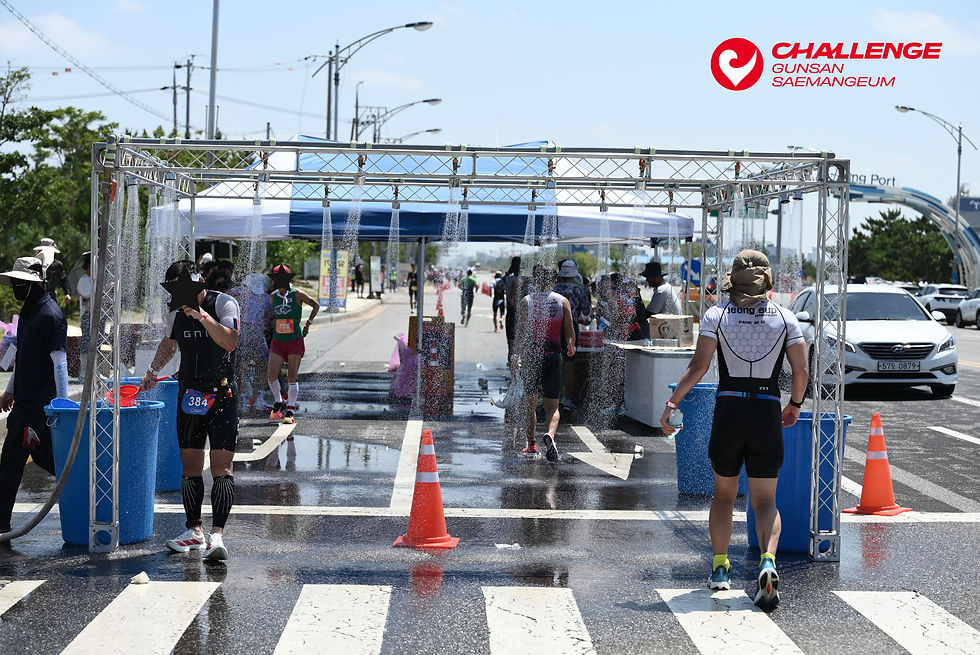
Overall, this run is incredibly tough. Not for terrain, but for climate. Organizers made every effort to combat the heat with ample aid stations (about every 1.25km) and cooling stations.
Finish Line: After the final lap, athletes head to the finish line. It is a fully carpeted finishing shoot with multiple announcers (in both Korean and English). A crew of people handed out medals, including the race director himself as well as some of the pro athletes.
A medical crew was available at the finish with options for communication in both Korean and English.
Athletes received cold beverages and snacks as well as iced/cold towels.
Note that there wasn’t a full meal available at the finish. There is a convenience store nearby for athletes to purchase larger food items.
The announcers did an excellent job. From transition set up to the final finisher and awards they brought excellent energy, enthusiasm and support.
Pre race meal:

The night before the race there was a pre race carbo dinner. This is rare for middle distance races in general. I had dietary requirements (vegetarian) which meant some of my options were limited (rice and pasta). Because these are high carb items, they were the first to be consumed. The food was restocked though, so this just meant heading up for a second (or third) plate.
The carbo dinner itself, was held at the official race hotel (the same location as registration).
Overall Rating: Based on the scoring guide criteria, Challenge Gunsan-Saemangeum received a perfect score.
However it is important to note my own error. I was not using a personal vehicle during this trip. Because of this I did not note parking location or ease of parking. I will note that the official race hotel did have underground parking. I can not speak to the availability of parking close to the venue. Because checking on this was my error I removed this criteria from the scoring guide.
Curious about how we score races? Take a look at our Scoring Guide here.
Pre Race Training And Accommodation
I definitely recommend staying at the race hotel. It should be reiterated that this is an industrial area and there are not many of hotel options close to the venue.
Because of how centrally things are located to the race hotel (carb dinner + packet pick up), it is the most convenient option. The pricing did not increase surrounding the race, and remained fair. The only "con" of the race hotel, is long waits for the elevator. This is consistent with any race hotel and athletes should expect extra wait times.
Swim training in a pool was difficult and required a 20+ minute Uber. However the organizers provided course previews the Friday and Saturday before the race. In my opinion, this is sufficient and a pool would not be required for most athletes.
Cycling from the hotel was convenient. The hotel is located on a main road. My suggestion is to take less busy roads that run parallel and do your bike prep on the race course/ Sea Wall. There are large bike lanes/shoulders and it felt safe to ride. Running on the sidewalk from the hotel was difficult as the sidewalk was poor quality. However, running on the less busy roads that ran parallel to the main road felt safe and accessible.
My recommendation is that athletes arrive 1-2 days before the race to reflect the industrial nature of the location.
Overall Rating: Based on the scoring guide criteria, Challenge Gunsan-Saemangeum is an excellent location. However it did lose marks for availability of restaurants (most would require vehicle access) and general bike shop availability. Should an athlete require a bike repair, the best option is to visit the expo. This means it is limited to the day before the race.
Curious about how we score races? Take a look at our Scoring Guide here.
Post Race Sightseeing
Most people I met headed to Seoul for sightseeing after the race. If you are sticking around the area Gunsan- Saemangeum area one of the most popular things to do is drive or bike the full seawall.
This is the worlds largest man made seawall, extending 33.9km. It connects Buan-gun County and Gunsan. Construction began in 1991 and took 19 years to complete.
Other things to do locally are:
Visit the Gunsan Teddy Bear Museum: Located: 37, Guyeong 7-gil, Gunsan, Jeollabuk-do 54022 South Korea
Visit: The Dongguksa Temple
Located: 6 Dongguksa-gil, 특별자치도 Gunsan-si, Jeonbuk State, South Korea
According to Visit Korea this Japanese style buddhist temple is the only surviving Japanese style temple in the nation. This temple was built in 1909 and run by Japanese monks before reverting to Korean jurisdiction in 1945.
Words to Know:
English is not widely spoken, especially in smaller shops or by volunteers, so knowing a few words can go a long way:
안녕하세요 Annyeonghaseyo – Hello
감사합니다 Gamsahamnida– Thank you
물 Mul -Water
Triathlons in Korea:
For most international locations, I would recommend flying into Incheon International Airport(Located west of Seoul;)airport or Gimhae International Airport in Busan for southern parts of the country.
IRONMAN Gurye
Changwon Masan Bay National Triathlon
Nakdong River Slow Triathlon Festa in Busan
Daegu Mayor's Cup National Triathlon Competition
Jeongnamjin Jangheung Triathlon
Naju Yeongsangang River Triathlon #2
IRONMAN 70.3 Goseong
Tips and Tricks:
Plan your nutrition in advance, including whether you’ll rely on the on-course aid stations. If you’re using the course nutrition, make sure to practice bottle grabs during training and check what products will be provided ahead of time.
Pack a flat repair kit, including spare tubes or CO₂ if you’re racing tubeless.
Bring your own pump for race morning if possible. There are some available in transition, but lines can get long and pressure gauges may vary.
Arrive early on race morning to allow time to check your bike and walk to the swim start.
Tip: Although your bike will already be racked in transition, you'll still need to pump your tires on race morning. While you're there, double-check that your bike is in the gear you want to start in, load your race-day nutrition, and take time for a short warm-up to get your body moving.
Race-Specific Notes:
Photographers on Site: Challenge Gunsan- Saemangeum provided event and course photographers. All photos were emailed to participants, free of charge. This is in direct contrast to many other race experiences where photos are available for purchase only.
Industrial Area: The race location is very industrial. To get into Gunsan, access a variety of restaurants, and/or training facilities- be sure to have apps like Uber installed on your phone.
Cost:
The local currency is the South Korean Yuan. At the time of writing, $1 CAD is approximately 1030 South Korean Yuan.
Credit & Cash
Credit cards are widely accepted. At no point did I carry any South Korean cash on me.
Tipping Culture
Tipping is not expected in South Korea and is not a common practice.
Accommodations
Close to the venue there are sufficient accommodations to support the race size. However, it should be noted that this is a very industrial area and more accommodations are available in the city of Gunsan. Should you plan on staying in Gunsan rather than close to the race, I recommend having access to a car.
This is one of the races that I do recommend staying at the official race hotel. Currently the race hotel is listed at $145 CAD per night. Two nights here would be sufficient (the night before the race and the night of the race).
Food Costs
Food in Korea can vary in price.
Meals at restaurants: $10–$20 CAD per person
Buffets, Western-style or tourist-oriented restaurants may cost more: $30-50 CAD per person
Transportation
Taxis and Uber services are available. I wasn’t successful using Lyft in Gunsan. The cost for me worked out to a bit over $1 per minute (ish). For example a 20 minute ride to the pool cost around $20 CAD.
I flew into ICN airport and the race organization provided transit from the airport to the race hotel. This was a long drive (2.5-3ish hours). I can’t speak to independently organizing this drive and would recommend reaching out to the race organizers for suggestions if you are travelling internationally as I can’t speak to things like public transit, car rental, cost of long car hire etc.
Race Entry Fee
For the 2026 race, the cost of an entry fee for Challenge Gunsan ranges from $280-$340USD (at the time of writing this, $380-480 CAD)for an individual (depending on when the entry was purchased. Purchasing early gives the cheapest rate) and $500 -$600USD (at the time of writing this, $705-845 CAD)for relays. . Note there is a promotion called “Hero of The People” for locals in South Korea. Depending on the year, organizers have given healthcare workers, teachers, or other "Heroes of the People” a chance to apply for free race entry.
Expo & Merchandise
There is no fee to enter the race expo, but as with most large races, vendors will charge for a wide assortment of products.
Please note that this post was written from my perspective and experiences. Your experiences may vary. Please read the Canadian travel advisory (or your own countries travel advisory) prior to travel.

